=====Random Optimization with FEMM=====
Issues that influence the application of optimization methods to FEMM problems include:
* //Expensive Cost Function Evaluation//. Each cost function evaluation requires a finite element analysis.
* //Discontinuous Search Space//. Because of discretization error associated with remeshing, cost functions typically don't vary smoothly or continuously vs. geometry.
[[http://en.wikipedia.org/wiki/Random_optimization|Random Optimization]] is a powerful method for use with finite element analysis because it accommodates both of these difficult issues. With inspiration from the Wikipedia page, the variant of the algorithm considered here is:
Let \(f\): ℝn → ℝ be the fitness or cost function which must be minimized. Let \(x\) ∈ ℝn designate a position or candidate solution in the search-space. The algorithm can then be described as:
* Initialize //x// with a random position in the search-space.
* Until a termination criterion is met (e.g. number of iterations performed, or adequate fitness reached), repeat the following:
* Sample a new position //y// from the hypercube of a given radius surrounding the current position \(x\)
* If \(f(y) < f(x)\) then move to the new position by setting \( x = y \)
* Now x holds the best-found position.
* If there is no progress in \(m\) iterations, shrink each linear dimension of the hypercube by a factor of 2.
This algorithm is good with respect to expensive function evaluation because only one function evaluation is needed to generate the next potential step. It is also well-suited to the discontinuous nature of cost functions applied to finite element programs, since it jumps to new optima rather than smoothly traveling. This feature tends to reject most local minima. Constraints are also easy to accommodate--if a randomly generated candidate solution doesn't meet all applicable constraints, it is simply rejected.
====Example: Minimization of a Simple Function====
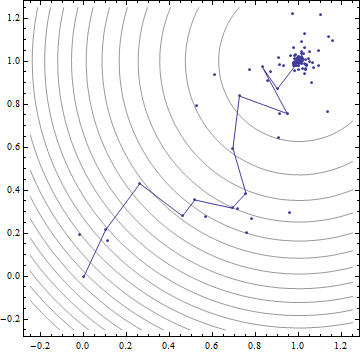
Before applying the method to a finite element problem, it is instructive to apply it to a simple problem with a known solution. Let cost function //f// be defined as:
\( f = (x_1 - 1)^2 + (x_2 - 1)^2 \)
In this case, \(f\) is a 2D quadratic function that is minimized at \([x_1,x_2] = [1,1]\). Although RO is an inefficient way to solve this particular optimization, it is an easily understandable and graphable problem. A Mathematica implementation of the algorithm is as follows:
R[]:=Random[]*2-1
f[X_] := (X - {1, 1}).(X - {1, 1})
d = 0.25;
m = 10;
stall = 0;
X = {0, 0};
fbest = f[X];
For[k = 1, k < 1000, k++,
Xnew = X + d*{R[], R[]};
fnew = f[Xnew];
stall++;
If[fnew < fbest,
fbest = fnew;
X = Xnew;
stall = 0;
Print[k, " ", d, " ", X];
];
If[stall == m,
stall = 0;
d = d/2;
];
If[d < 0.001, Break[]]
]
The output of the program, with the iteration number, step size, and position for each cost function-reducing move, is:
|
|