Frozen Permeability Benchmark
Introduction
“Frozen Permeability” is a method of ascertaining motor parameters that are valid for a motor running under saturated conditions. See [1] and [2] below for examples of its application. To evaluate motor parameters via the Frozen Permeability method, a first nonlinear simulation must be performed with the machine at load. Then, subsequent simulations are performed using the element-by-element permeability obtained in the original nonlinear simulation (i.e. the “frozen permeabilities”). This Frozen Permeability functionality has recently been added to FEMM (in builds from 14Jun2016 and later). The purpose of this note is to provide a benchmark problem demonstrating the program's Frozen Permeability capability.
Benchmark Problem
A good benchmark problem is described by Chu and Zhu in [3] and [4]. This paper considers an inset permanent magnet motor shown in Figure 1 and available for download at the bottom of the page.
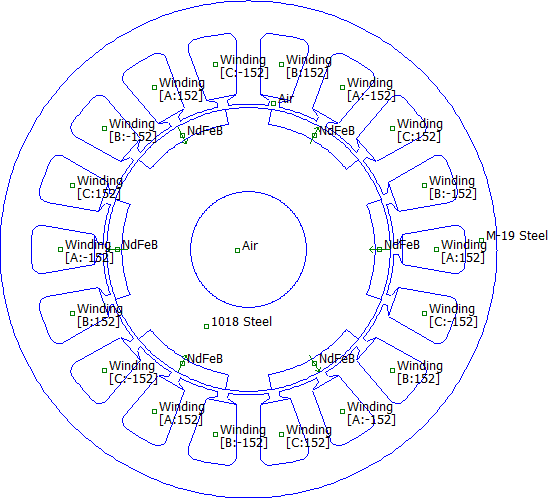
Figure 1: Inset PM Machine from Chu and Zhu.
The machine has the attributes listed in Table 1. Many of these parameters are listed explicitly in [3], but other attributes were either inferred from measurements of Chu's Fig. 1 geometry or simply assumed (particularly the specific choice of materials).
|
|
Field Separation
Part II of Chu considers the specific case where the phase current amplitude is 4Apk and the phase angle is β=0 (where all current is along the q-axis). Simulations are performed for
- The “whole” field, i.e. the nonlinear operating point with the combined influence of the permanent magnets and phase currents. This situation is modeled by zhu.fem;
- A frozen permeability solution, where element permeabilities are taken from the “whole” solution, considering just the contribution of the phase currents. To “turn off” the magnets, the Hc of the PM material is set to zero. This situation is modeled by zhu-i.fem;
- A frozen permeability solution, where element permeabilities are taken from the “whole” solution, considering just the contribution of the permanent magnets. The coil currents are set to zero.This situation is modeled by zhu-pm.fem;
The resulting field distributions from each of these solutions are shown below as Figure 2.
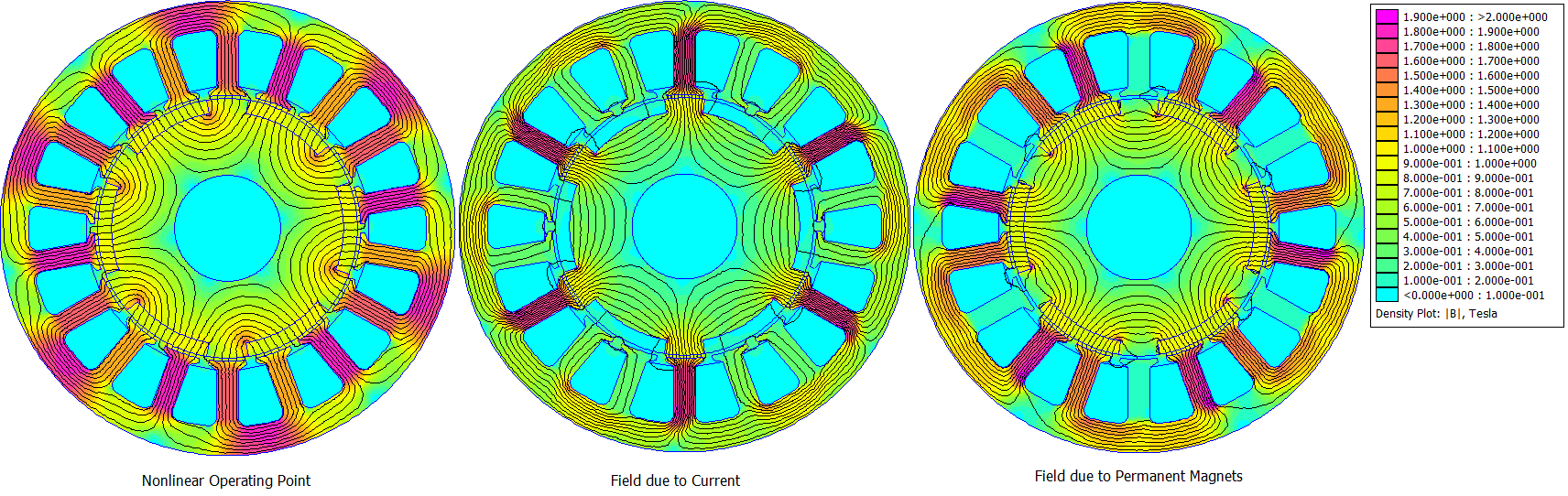 Figure 2: Total field from Current+PMs and Separate Plots for Individual Field Components.
A plot of the normal component of the field in the middle of the air gap is shown in Chu's Fig. 5. The information from Chu is shown with the analogous plot generated via FEMM in Figure 2 below. The Mathematica code used to generate the script is available as zhu.nb and zhu.pdf As can be observed, the plots look the same, showing that FEMM has successfully analyzed the benchmark frozen permeability problem.
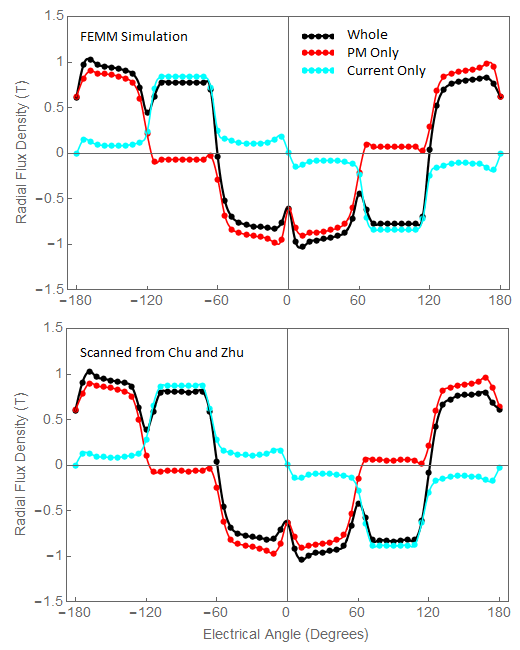
Figure 3: Comparison of FEMM frozen permeability simulations vs. results in [3].
Conclusions
A benchmark Frozen Permeability problem has been described. An analysis via FEMM produces the same results as shown in reference [3], indicating reasonable performance by FEMM for this problem type.
In the future, this example may be extended to show average torque separation computed via FEMM and parameter identification via FEMM for this same benchmark problem.
References
[1] D. Gerling “Comparison of Different FE Calculation Methods for the Electromagnetic Torque of PM Machines,” NAFEMS Seminar: “Numerical Simulation of Electromechanical Systems”, 26-27Oct2015, Wiesbaden, Germany.
[2] E. Schmidt and Marko Susic, “Parameter Evaluation of Permanent Magnet Synchronous Machines with Tooth Coil Windings using the Frozen Permeabilities Method with the Finite Element Analyses,” Electrical & Computer Engineering (CCECE) 2012, 29Apr-02May2012.
[3] W. Q. Chu and Z. Q. Zhu, “Average Torque Separation in Permanent Magnet Synchronous Machines Using Frozen Permeability,” IEEE Transactions on Magnetics, 49(3):1202-1210, Mar. 2013.
[4] Z. Q. Zhu and W. Q. Chu, “Investigation on Torque in PM Machines,” EUGM 2014, 04Jun2014.